 Just felt like posting but I don't have any of my equipment related stuff completed just yet so...Dreading this drive to work has been on my mind lately. I just really don't want to make it anymore. 35+ miles which takes nearly 45 minutes to an hour. It's time for a change.

Monday, January 25, 2010
Don't Make Me Go
Just felt like posting but I don't have any of my equipment related stuff completed just yet so...Dreading this drive to work has been on my mind lately. I just really don't want to make it anymore. 35+ miles which takes nearly 45 minutes to an hour. It's time for a change.

Thursday, January 21, 2010
The Abduction
 They came from above,
 amidst a fog that loomed for days.
 Our curiosity like that of an insect,
 we were taken.

Saturday, January 16, 2010
The Micro Four Thirds System - The Panasonic Lumix DMC-GF1

As soon as I first read about this camera I was hooked. The concept seems simple enough, something I (and I am sure many others) have dreamt about since joining the digital revolution. Sometimes to the extreme, "Just give me a sensor and a shutter, that I can stick an optic on!" Whatever the case, Panasonic's GF1 fulfills a niche, a need really, within my camera kit, the joy of which I can hardly begin to describe (a little over the top? I'm sorry, I swear this thing is just that cool!).
Micro Four Thirds and the Camera Continuum:
After having shot film for a substantial number of years (not nearly as many, relative to others, considering my age) my first digital camera was a DSLR, a Canon XTi to be exact. While looking for my first digital camera, I of course initially began looking at compact point and shoots (P&S). Being that the price of DSLRs was so much higher compared to P&Ss, I figured it would be a good intro into the world of digital while, depending on the model, affording me some creative tools to continue making images in a similar fashion to what I was currently used to. Not so. In fact, it was nothing short of impossible for me to fathom surrendering the many fully manual functions I possessed within my DSLR, in a considerably less expensive P&S. So in narrowing down my decisions, I kept ending up back at cameras like the Canon Powershot G series, or something similarly near a $500 pricetag. Well for that kind of money, I could get an entry level DSLR!
I became discouraged from buying a P&S further by the fact that their performance. Even those with the full manual controls, paled in comparison to the DSLRs. Now at the time, it wasn't a huge deal. Size wasn't really a concern and being the tech junkie that I was (and still am) I thought, "I actually WANT one of those beastly looking tank cameras!" Not that I am overcompensating...Just liked the idea of having a solid, robust piece of machinery in my hand.
In any case! I ended up going the route of the DSLR. No regrets, never looked back. For most tasks, nothing compares in quality, to date (though it seems that is changing). I have continued to have a hard time justifying forking over $500+ for a P&S sidekick camera, that will only leave me grabbing the DSLR to get what I need. It wasn't until I began doing some photojournalism that I really began questioning the DSLR. I was actually finding that despite its creative superiority, it's size was a big problem (no pun...). People often altered their behavior upon seeing it. That coveted cloak of invisibility to preserve journalistic accuracy only became more illusive. People did not seem to mind, however, seeing me with a small P&S camera. Well on a bright, clear day under average conditions, with a modest output size (4x6 print, web image), a P&S can produce some very nice images. So I picked up a Canon G9 gave it a try. I found it to be a very reliable camera, as well as discreet. The lack of mirror box allowed me to take nearly silent shots, in comparison to the thundering clack of the DSLR. Still, the G9 (as well as almost all P&Ss) had some shutter lag, lacked any real burst capabilities, had a fixed lens. Worse yet, it performed fairly sketchy beyond ISO 800. Well humans have made do with what they had for thousands of years and I'm certainly not here to complain. Technology just wasn't there yet.
Enter the "Poor Man's Digital Leica":

The Micro Four Thirds System is great. Let me first just say, the GF1 is by no means perfect nor is it the "end-all be-all". Along with Olympus's EP1 and EP2, it represents a revolutionary new niche in digital photography. One that is empowering, as well as affordable (unlike the supremely expensive Leica M9, $7000 worth of awesomeness). My excitement is probably more directly related to the conceptual implications the Micro Four Thirds System represents.
I will delve further into the specifics with some ISO comparisons and more DIY projects involving the GF1 in the future. But generally what does the Micro Four Thirds System (M43) have to offer? The M43 system is based on the Four Thirds System developed by Olympus. With the M43 system, you get basically, a Four Thirds sensor (that is roughly 30% smaller than an APS-C sensor, and a 2x crop factor, same as the Four Thirds System cameras), in a thin pocketable body. The mount is called a Micro Four Thirds mount. It is smaller than the standard Four Thirds mount and lenses from the latter are compatible through an adapter.
Why It Matters:
The sensor in these cameras is 9x that of standard P&S. Larger sensor, means larger photo sensors in the chip as well as shallower depth of field capabilities. ISO performance is much better than P&Ss. The camera itself has DSLR-like shutter lag, hardly any. Burst modes. Relatively quiet. And most important of all, because of its lack of a mirror box the flange to sensor distance is short enough, with the right adapter, virtually any and every lens ever made for a film camera can be used on this camera.
The bundled Panasonic Lumix 20mm f/1.7 Pancake lens is a compact gem of a lens that gives the beautiful shallow DOF feel of a DSLR or even the older film compacts.

Of the various options currently available in the M43 system, it seems the GF1 is the most capable and well thought out at this point. Plus, the bundled 20mm f/1.7 was a big sale point for me. In getting a small camera such as this, having an ability to utilize depth of field is incredible.
Changing the Way We Shoot:
I used to lug my D700 around everywhere, just in case something came up. I love making images. The P&S was just convenient but in the end I was often looking for more in the images that came out of it. New cameras like the M43 cameras, or Ricoh's new GXR are redefining how we think of compacts. Utilizing the newest technology, these companies are putting the power of the DSLR is our hands, without the weight, social impedence, or just outright inconvenience. Take as you will, but it is happening. I for one, am embracing full heartedly. The images are still made by the photographer, no matter how large or small the camera is.
Links:
Wikipedia's article on the Micro Four Thirds System
DPreview - Panasonic GF1
Friday, January 15, 2010
Belated Seasons Greetings

Early Morning - 20mm f5.6 1/3200 @ ISO 100
Well it has been exactly one month since my last post. I certainly do have some catching up to do. I wish I could say it was because I was off on some exotic vacation but that simply isn't so. The truth is I have just been very busy and directed much of my free time towards enjoying the company of those dear to me. All in all it was a wonderful, relaxing holiday season.
I had an excellent christmas this year not only because it is always great to get some real time to kick it with my family but also because despite a rather dry winter, we got snow on Christmas morning. To add to it all Santa read up on his camera gear this year.
As of this season, I have am a proud member of an up and coming camera system. No, I haven't gone to the dark side...(cough, CANON!). Although, I would love a 5D mk II but shh, don't tell anyone! After much reading/lusting/deliberation I came to the conclusion that while the micro four thirds (M43) cameras may not be quite there yet, I simply couldn't help myself. The portability, superiority over traditional digital compacts, and the adaptable mount. The possibilities seem endless. Not to mention that fact, that even if the GF1 isn't the perfect solution, I feel the glass is here to stay. I looked long and hard between the GF1, the Olympus EP1, and even the newer EP2. I scoured rumor forums in attempt to glean whether something newer and further improved was imminent. Still the GF1 seemed to reign in as an excellent piece of hardware. As with any new endeavor, the m43 system is not perfect and more than that, still quite expensive in relation to the DSLR market. Not having a lot of money was certainly the only factor holding me back.
Well my loved ones did it for me. And I have to say I'm extremely impressed! I'm thrilled! While these little cameras definitely have some kinks to be worked out and by no means replace the DSLRs in terms of quality, they open all kinds of new doors in the world of photography, not imaginable since the invention of the 35mm rangefinder!
I have a lot of posting to do and catching up in terms of promised comparisons, some of which will be largely aided by the GF1. And I plan on going into more depth/practicality discussion over the GF1 in my next post. Because, to be quite honest, this camera has been out for some time. This blog isn't about the newest and latest and greatest. I couldn't afford that, haha! It is just someone else's point of view and hopefully supplementary to what you have already read.
Below are just a few examples I have made thus far with the Panasonic GF1 and the 20mm f/1.7 pancake lens. They have been bumped a tad with some curves and a bit of saturation as I find when I post these to the web, they are significantly desaturated. All were shot in .jpg as well as mostly on aperture priority and auto ISO.

Ashley - 20mm f1.7 1/60 @ ISO 640

Frost - 20mm f/4.0 1/1600 @ ISO 100

Jana - 20mm f1.7 1/60 @ ISO 800
Sunday, December 13, 2009
The Vivitar Macro Progression
I actually just found an excellent write up on the differences between the Vivitar macro lenses as well as perhaps some of the reasoning for the various manufacturers and labels. Now currently I can neither confirm or deny any of these explanations and most likely find them just as interesting as you! Certainly, if you have any further insight feel free to share! The information below was found here:
http://forums.dpreview.com/forums/readflat.asp?forum=1036&message=30049551&q=vivitar+100&qf=m
A dpreview.com member, Lewtwo, posted this (requoted from a fellow called "Boggy" of the Kiron-Klub forums of yahoo here: http://groups.yahoo.com/group/Kiron-Klub/message/20810) which is perhaps the progression of the Vivitar macros:
- Vivitar 90mm 2.5 Series 1 was made by Tokina, followed by
- Vivitar 90mm 2.8 produced by Komine, followed by
- Vivitar 90mm 2.5 uprated version of #2, produced by Komine, followed by
- Vivitar 100mm 2.8 produced by Kino, modified version of the Kiron 105mm f/2.8 Macro, followed by
- Vivitar 105mm 2.5 Series 1 uprated version of the above, also produced by Kino
and that the Komine produced Vivitar 90/2.5 served as base model for the 1:1 derivates like Elicar, Rokunar and Soligor
additional info on later request: approx. production periods for these lenses
- Tokina made 90mm f/2.5 1976-78
- Komine made 90mm f/2.8 1977-79
- Komine made 90mm f/2.5 1980-83
- Kino made 100mm f/2.8 1985-87
- Kino made 105mm f/2.5 1987-9?
Thursday, December 10, 2009
Vivitar Series 1 - What's all the Hoopla About?

So what's the deal with me and Vivitar? Why are over half the lenses I have reviewed and poured over from the 1970's and 80's and made by a now obscure third party brand; a brand most likely associated with garage sales and giveaway 35mm cameras from Legends of the Hidden Temple (by people of my generation), if recognized at all? What's the deal with all the sensational terminology like "legendary" and "cult status"? If Vivitar lenses were so great, what happened, why doesn't anyone talk about their new series 1 lenses?
Perhaps this article would have been more useful if written earlier in the blog for those not yet familiar with the Vivitar culture, but now is as good of time as any seeing as how I too have been learning more about Vivitar all the while in my personal observations and testings of their lenses. After all, it doesn't make any sense for someone to develop brand loyalty with little to no experience with the product.
A Brief History
Vivitar was a photo sales company founded in 1938 by two men, Max Ponder and John Best. Based out of Oxnard, California, the company got its start by selling imported German photo gear and later expanded to distributing Japanese made equipment following the conclusion of WWII.
For the sake of this article I will relegate most of the information to the Series 1 line specifically, despite the fact that Vivitar produced a wide variety of successful photographic equipment including the famed Vivitar 283 and 285 model flashes.
It was in the 1970's when Ponder and Best introduced the Vivitar Series 1 line. Interestingly enough, Vivitar was not a camera or lens manufacturer. It was a sales company. Boasting computer designed optics, the lenses would be contracted out to various manufacturers providing a less expensive alternative to the big name-brand lenses without sacrificing a whole lot of quality. In fact, many of the Vivitar lenses rivaled those of the high end lenses of the day. Vivitar technicians were the dreamers, pushing boundaries and attempting things that were unheard of in that day, and passing on the technology and savings to the photographers.
Zooms are a given in today's photographic world but in those days, primes were standard practice. Companies like Tokina got put on the map for their innovation in zoom lense technology. Vivitar, likewise, became well known for their 70-210mm zoom with macro function (Gandy). Some of their primes still today outperform many lenses and remain high on the MTF test charts. Especially the Vivitar Series 1 90mm f/2.5, a.k.a. the Bokina.
So what happened to the company? Often times it only takes one or two people to really make a huge difference and likewise, without them, everything falls apart. With the passing of Ponder and Best, Vivitar (according to Wikipedia) "drifted" between different owners, losing it's innovative edge. Interestingly enough, in my search to find parts or someone to help with a lens modification I contacted a lens design company out in California and ended up learning a little more about the demise of Vivitar. Apparently, in 1994, an earthquake, later deemed the "Northridge Earthquake" struck southern California, leaving large areas devastated. Wouldn't you know it, the Vivitar headquarters was among the casualties. Already struggling by this point, it seems the earthquake provided a final blow.
Perhaps some exaggeration lies in just how severe the earthquake affected the Vivitar company, it can at least be agreed it didn't help. In 2006 the company was bought (Syntax-Brillian Corp.), then again in 2008 (Sakar International) after filing for bankruptcy. Even now, if you call the Vivitar company, they provide no support and retain no relation to the Vivitar corporation of old.
A Different Time
It's nothing new, a company going out of business. But it's sad to see a company, that did so much for the photographic industry just fade away. Even worse, the new Vivitar company has, at least as most recently as this past year, been producing lenses bearing the "Series 1" name (Like the 500mm catadioptric, 650-1300mm, 7mm fisheye, 19-35mm, and so forth). I would call them misnomers because despite having the rights to the brand name, these lenses are in no way near the optical quality of those designed by Ponder and Best in the 70's and 80's. In most cases, I don't know that Vivitar has anything to do with the design. You can find the exact same lenses for sale under various other names like Bower, Phoenix, Promaster, and more. So someone must be responsible for the original design and then it gets rebranded all over the place! But again, they lack that signature Series 1 innovation, as well as optical quality.
Are Series 1 Lenses All They Are Cracked Up To Be?
Absolutely... to me. I think this is a personal issue. I mean, things like Photodo.com's MTF tests indeed show lenses like the 90mm proving themselves on the scientific "mat" if you will. But some of their Series 1 lenses had optical shortcomings, like any other lense. They aren't infallible. As always, it comes down to what you want out of your glass, and what you think it is worth. I pay good money for these lenses when I find them in good condition, even if I could save some money by finding one in bargain condition, because even the cosmetics mean a lot to me. Call it what collector's have (I am by no means a real collector because I use all my lenses) but I love having one of these older lenses in like new condition. It's downright exciting! Sure some lenses show color fringing wide open, others have light fall-off, and so forth. But, they emulate an era. They have a nostalgic air about them. As I often note in my reviews, you pick one up and it seems as if it has been cast or carved from a single solid piece of raw material. It is all of these qualities that make shooting with these lenses such a joy! Truly, some do perform extremely well but realistically, if you have the money to spend, of course their are much better lenses out there (in MOST cases, I have a hard time feeling that way about the 90mm, it is simply stellar). Auto-focus, Vibration Reduction (VR), Nano coatings, and all sorts of cutting edge technology adorn the newest members of the photographic legacy. But to me, the Vivitar Series 1 glass still maintains an excellent balance between nostalgia and performance and thus defending their coveted slots in my bag.
Sources
The history written here was gathered from these two sources and as I said, the gentleman I spoke with at another company's lens design facility.
Wikipedia
Stephen Gandy
Tuesday, December 1, 2009
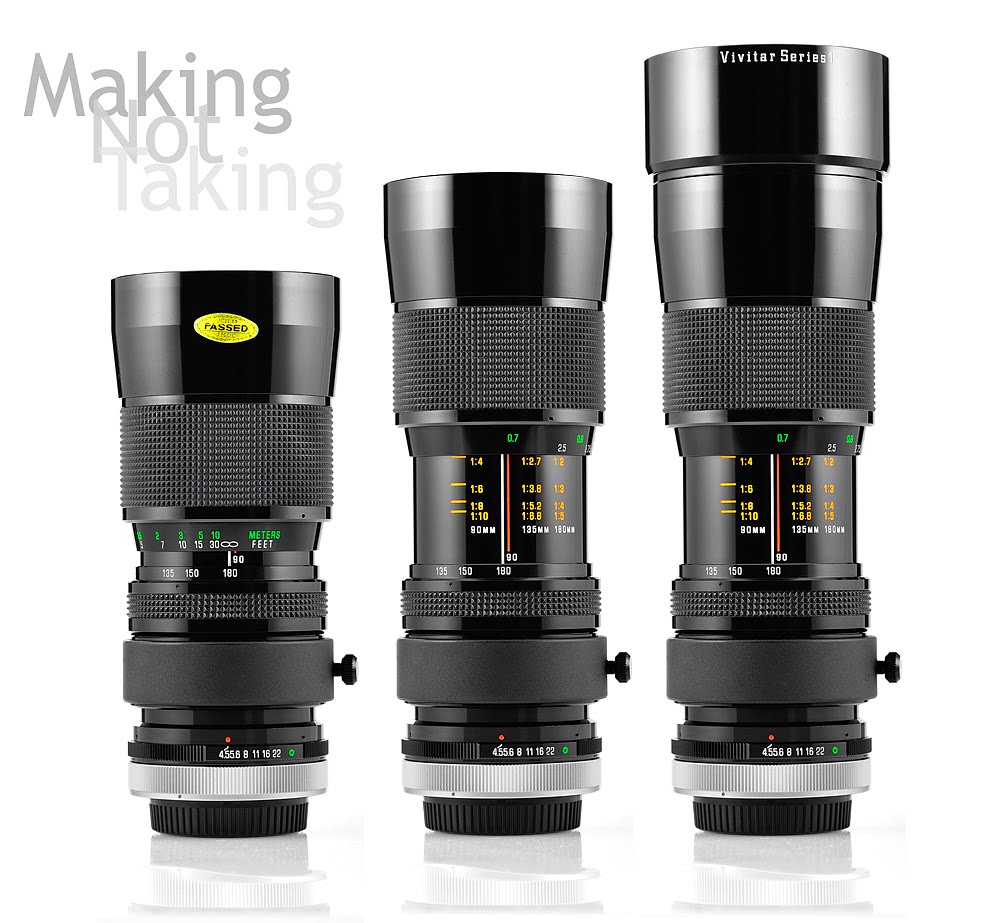
Vivitar Series 1 90-180mm f/4.5 Flat Field Macro Lens

The Vivitar 90-180mm f/4.5 macro lens is a truly unique and exquisite lens. As of now, I only state this based on its physical appearance as well as reading about its reputation. Just how amazing of a lens it really is or how usable it is to me has yet to be determined. In my ongoing quest to acquire and test all the Vivitar Series 1 lenses I can get my hands on, mostly primes and macros, this is my most recent find.

The condition of this lens is perfect. Found it for $60 on craigslist a few weeks back. Actually had it shipped, the seller was incredibly nice. Only caveats, slightly dented filter ring so getting the hood on takes a little work. Also it is in FD mount and I need Nikon, I will figure something out! It will be my last lens for awhile as I have other financial priorities at this time and simply cannot allow LBA (Lens Buying Addiction) to overtake my reason! I have more than enough testing and shooting to do with the lenses I have now anyhow.

So onto the lens! The Vivitar 90-180mm f/4.5 is a true macro zoom in that it was designed as a flat field lens for excellent macro reproduction. Most lenses are design where the focal plane is an arc with all points equidistant from the film plane. In macro photography, especially something like reproduction with items which are flat, this would mean when filling the frame with something such as a stamp, while the center would be in focus, the outer edges would actually be outside the plane of focus. Flat field optics provide a plane of focus parallel to the image plane. Most true macro lenses are designed this way for reproduction.
According to most forums and postings from users of this lens, it produces amazing results. Guess who made it? The serial begins with 22- Kiron! To determine who made your Vivitar Lens see my links or simply see Stephen Gandy's "Who Made That Vivitar Lens".
Specifications
Focal length: 90-180mm
Filter thread: 72mm
Min. Aperture: f/4.5
Max. Aperture: f/22
Angular field of view (diagonal): 27°
Elements/groups: 18/12
Min. focusing distance: 27" (68.6 cm) @ 180mm
Max reproduction ratio: 1:4 @ 90mm, 1:2.7 @ 135mm, 1:2 @ 180mm
Weight: 2.4 lbs. ( 1.1 kg)
Vivitar 90-180mm f/4.5 Lens Diagram

Aesthetics/Ergonomics

The Vivitar 90-180mm f/4.5 is no exception to the superior build quality of the other Vivitar Series 1 glass I have reviewed thus far. Beautifully and precisely crafted with exact tolerances, a durable barrel, multi-coating, smooth movements, and an overall professional, appealing appearance. The lens utilizes a dual focusing mechanism where the lowered diamond knurled ring zooms the lens from 90-180mm and the upper, equally knurled, ring focuses. In addition to the heft of the lens, it features a rotating tripod collar with tightening screw. I find these mounts a great design addition however I am typically unable to take advantage of them because of lack of room when shooting with a battery grip.

 Performance
Finally got my FD-m4/3 adapter. When those Chinese merchants say 20-60 business days, they mean it. It felt like an eternity waiting for this thing. Anyway, because I am using this lens on a four thirds sensor, there is a 2x crop factor and I and getting the sweet spot of the lens. Therefore I cannot fully assess this lens' capabilities nearer the edges of a full frame image.
With the GF1, this lens is great. (Be sure if using it with an m4/3 camera, to use the lens' tripod mount rather than the camera. This brick just may tear the mount right off the camera!) Below are two samples @ 90mm and two more @ 180mm, at f/4.5 (wide open) and f/11 (my sample's sharpest aperture).
f/4.5 @ 90mm
 f/11 @ 90mm
 f/4.5 @ 180mm
 f/11 @ 180mm

 f/11 @ 90mm
 f/4.5 @ 180mm
 f/11 @ 180mm

Wide open, the Vivitar 90-180mm is soft for sure. But this lens gets crisp and clear when stopped down, best at f/11. I am new to the GF1 so it is possible another factor is in play causing the f/4.5 results to be so soft. Otherwise, the lens is relatively unusable at this f/stop.
Links/Resources
Below, found on Ed Sawyer's site, is some scanned documentation from Modern Photography's own review and testing on the Vivitar 90-180mm. I just pasted it all together in PS.
 Robert Monaghan's Write-up of the Vivitar 90-180mm on his Cult Classics webpage:
"Vivitar also made a number of high quality zooms under the Series I label. The 90mm to 180mm f4.5 flat-field VMC lens from 1978 is an optic that has also achieved cult status.
This Vivitar 90-180mm f/4.5 lens was really designed for medical photography needs. A ring-light flash unit was designed to mount on the front of this lens too. But as far as I know, it was never released. This original medical market niche explains some of the design features and range of this high quality zoom lens.
....The Vivitar 90-180mm f/4.5 Series I macro zoom is designed to provide the highest possible quality continuously down to its closest macro settings. The Vivitar 90-180mm f/4.5 flat-field lens provides high quality macrophotography continuously from 90mm (to 1:4) to 180mm (to 1:2). That's unique, and useful, so you should expect to pay quite a price premium for such a cult status lens!"

Source: Modern Photography, June 1978, p. 126, 182
Again - The above text is all from Robert Monaghan's webpage on cult classic lenses.
Stephen Gandy's write-up on the Vivitar 90-180mm
Vivitar 90-180mm FD-M42 Mount Modification
Subscribe to:
Posts (Atom)