
Sunday, May 2, 2010

Tokina AF 100mm f/2.8 AT-X Pro Macro 1:1


October 2010

I have since acquired the Tokina 90mm f/2.5 AT-X "Bokina". The Tokina 90 has been my go-to lens ever since my first day of owning it. Granted it does not get down to 1:1 without the inconvenient addition of it's paired macro extender, but the sharpness I can achieve wide open is excellent. Not to mention it produces wonderfully sharp, contrasty images at every other aperture as well. I also don't see as much CA under the same shooting conditions as I do with the Tokina 100mm (This is a very minimal amount in either case, however.). In relation to the Vivitar S1 90mm, I find I just prefer the results of the Tokina 90mm.


Although my favorite macro lens that I have ever used is the sharp, robust Vivitar Series 1 90mm f/2.5, this is not the lens I use daily, or even to photograph everything on this site (it is what I used to make the images of the Tokina though!). Instead, I always grab my autofocusing Tokina 100mm f/2.8 AT-X Pro. Funny, I just about never use it in AF mode.

Specifications


Focal length: 100mm
Max. aperture: f/2.8
Min. aperture: f/32
Elements/Groups: 9/8
Minimum focusing distance: 11.8 in. (30 cm)
Macro ratio: 1:1
Focus limiter: 1.28 to ∞
Number of aperture blades: 9
Filter size: 55mm
Dimensions: 2.9 in. x 3.74 in. (73mm x 95.1 mm)
Weight: 19.0 oz. (540 g)
Hood: Dedicated, BH-551
Mount availability: Canon and Nikon

Optical Diagram


Specs as provided by: http://www.tokinalens.com/products/tokina/afl-m100-b.html

Aesthetics/Ergonomics


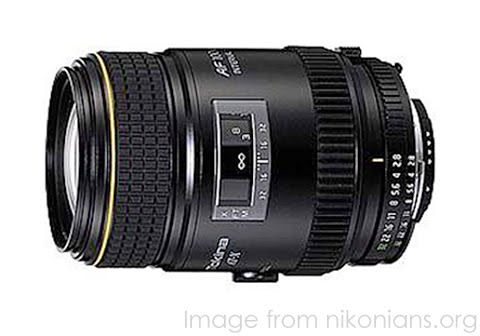
The Tokina 100mm AT-X Pro appears to have had a predecessor but only in that the other lens shared the focal length. I believe the Pro version is a new optical formula. The previous Tokina AF 100mm f/2.8 AT-X only when to 1:2 reproduction ratio whereas the newer Pro goes all the way to 1:1. I have not used the older version nor can I find very much info on it since every search attempt is dominated by results from the similarly named, newer Pro model. The 1:2 version looked like this (image from nikonians.org):

My guess would be that this older version bears the same build characteristics of the early Tokina AF 17mm AT-X. Because of the different optical formula and newer coatings, I surmise the 100mm AT-X Pro is a completely different animal. Consequently would not think my observations of the Pro applicable to the former.

The exterior of the Tokina 100mm f/2.8 AT-X Pro possesses the signature "Armalite" coating as well as the gold band denoting Tokina's professional grade build. It features two rubber grip rings, the larger being the focus ring and the smaller most likely a grip for mounting and unmounting the lens. The front element sits well recessed within the housing of the lens. Combined with the copious OEM hood, the Tokina 100mm is well protected from stray light and flare. Even when the lens is extended to 1:1 reproduction, the front element remains proportionally the same distance from the lip of the lens.


Function


The 100mm f/2.8 AT-X Pro features Tokina's AF/MF clutch mechanism at its best! Unlike the 28-70mm f/2.8 AT-X Pro where you must engage the MF by pulling the focusing ring back toward the camera, which you can only do at a specific point in the rotation of this ring, and then still be sure to switch the camera to MF as well, Tokina's new mechanism is streamlined and effective. With the 100mm, you can pull the ring back at any point in its rotation and you do not need to switch the camera to MF. It is as easy as engaging the clutch!


The 100mm AT-X Pro has a focus limiter switch near the base. When you are focusing right up near 1:1 and are utilizing AF you can turn the switch to "limit". Rather than the AF hunting all the way from minimum focusing distance to infinity, it will instead focus from 1:1 to a nearer pre-set (non-adjustable) point midway along the helicoid. This can save vital time, especially when photographing small moving subjects.

Performance


Tokina claims newer coatings optimized for digital sensors aid this lens in producing controlled color and great contrast. As much as I love my "Bokina", it is because of these newer coatings and the ample shading (hood, recessed element), that I choose this Tokina to shoot under strobes. I get great images devoid of any veiling (loss of contrast). I also love that I can go from 1:1 easily without the need for any extension tubes or macro extenders/converters. AF is great and fast enough for my needs with little bugs. Honestly, I typically use this lens in MF, which is a snap with the newer clutch.

I haven't noticed the out of focus rendering to be especially amazing but it looks great. Hard to live up to the "Bokina". At first glance, performance at infinity looks good. I have more testing to do on that before I can say for sure. I really don't buy macro lenses to do work at infinity though. Portrait-wise, the lens is great. Again, not my primary use but I have made a few images. Better portrait lenses exist.


As I said earlier, all the equipment reviewed on this site has been photographed with this lens. Simply put, the Tokina 100mm is an excellent macro lens! Technically speaking, in tests and comparisons with its contemporaries, the Tokina 100mm f/2.8 AT-X Pro does not score the highest on MTF, nor does prove the best overall. In fact, among some of the other lenses I have seen it compared to, such as the Tamron SP 90mm f/2.8 Di 1:1 AF and Sigma 105mm f/2.8 EX DG, the Tokina 100mm actually produces a little more CA.

Why choose the Tokina 100mm f/2.8 AT-X Pro?


Since I have not actually shot with the Tamron or the Sigma, or any of the touted superior AF Micro-Nikkors, it would be ill-informed for me to suggest this lens over those alternatives. Also, as I said, some comparisons would suggest otherwise. I picked this lens up because I got a good deal on one and wanted a macro with AF. Also, I'm practical. And practically speaking, this lens produces sharp, contrasty images, typical of Tokina engineering. It does produce noticeable CA in high contrast situations, just not enough to cause me to find a new lens. And in even more serious cases PP can do wonders, but I rarely ever even do that.

If the review seems less than raving, that's because it is. The Tokina 100mm f/2.8 AT-X Pro is a solid, reliable performer. It may not be the best in its class, but for the money, Tokina always comes through with admirable performance on a budget. The build guarantees this lens will last and the digitally optimized coatings do wonders when shooting in bright situations. Because I haven't done a whole lot of comparisons to other AF macros, all I can say is that the Tokina 100mm is a great all around performer and well suited for practical application, everyday shooting.

Saturday, April 24, 2010

Tamron SP 400mm f/4 LD-IF 65B - It Has Arrived


I don't know why, but I have been especially anxious about receiving this lens. It could be due to my new found appreciation for the fast, super telephotos. It may be the sheer size of these beasts and an accompanying gratification that I am getting, at least in weight, what I paid for. Whatever the reason, it has arrived!


The Tamron SP 400mm f/4 LD-IF (65B) Adaptall lens is somewhat of a rare lens. After a lot of shooting with the Tokina 300mm, I realized I often attach the 1.4x teleconverter and just about always shoot at f/4 or more (f/2.8 is bit too soft). Because of this, I began looking for possible alternative prime lenses which were somewhere in the ballpark on price but perhaps a little more tailored to longer shots. I checked out some of the 300mm f/4 lenses too, which can be had for relatively meager prices these days, even with AF. But again, 300mm is a bit short and when considering I will want to use TCs to extend whatever lens I use (because why not always have the option for that little extra reach) somehow 300 2.8 and 400mm f/4 seemed to be the cut-offs. I was mainly looking at the Nikon 400mm f/3.5 but I have just been having a hard time finding one that hasn't been beaten to a pulp and isn't 2 grand. There is hardly any info out there on the Tamron SP 400mm and it was pure chance that I stumbled across this one.

Specifications

Focal length: 400 mm
Model: 65B
Aperture Range: f/4-32
Angle of View: 6.2°
Optical Elements/Groups: 10/7
Min. Focus (From Film Plane): 118" (3.0 m)
Filter Size: 43mm (Rear), 112mm (Front)
Max. Diameter: 4.6" (118 mm)
Weight: 80.1 oz (2270 g)
Lens Hood: Bayonet #39FH

Physical/Cosmetics - First Impressions


This is my first Tamron Adaptall lens, ever. I know nothing of their build quality but I believe they have a great reputation according to many of the forum posters with their Adaptall and Adaptall-2 line. My first thought when I pulled this lens out of the bubble wrap was it seemed...lighter than I expected. Sure, I could have just read the weight on the adaptall-2.com site (and I did). But it is just different when you are holding the lens in your hand. As stupid an observation as it may be, when you flick this lens barrel, or give it a little knuckle tap, sure it feels solid, but the Tokina literally feels like a brick made of metal. In that respect the Tokina 300mm MF just seems a bit more indestructible. But given the age of this lens, and its condition, I am not worried about it lasting because it is still a professional quality lens.

The second thing I noticed when mounting this lens is that there seems to be a tiny bit of play in the setup. I have read a few reviews in various forums describing this lens as being poorly constructed, or at least less than ideal and specifically making comments about the adaptall mount. The adaptall mount system is universal. I think it is brilliant for a third party manufacturer; that is, in its more conceptual form. Making a lens mount system that can truly adapt to many brands, that is equal to an original OEM mount is a great undertaking. I think Tamron did very well! Yes there is some play in the mount. But I have used teleconverters with more play than this mount has. So this issue is acceptable to me. Also, the tripod mount on my lens is faintly ajar. I may be able to tighten this via the four visible screws. I only noticed when I mounted this lens on the tripod and even after being secured there was a faint bit of movement. The bayonet hood is another source of less than perfect tolerances. Being tension mounted, the hood doesn't sit 100% locked in place. Once the flanges clear the retention springs, the hood has a fraction of a millimeter to move. These issues are relatively small but I note them because I have not seen these types of mechanical shortcomings in my Tokina 300mm, my only comparably lens as of now. So despite the esteem of the optics and the price, don't expect to be wowed by the build.

It is possible all these slight inaccuracies are a result of wear over time. I am perfectly fine with that explanation. Because quite honestly, none of these factors affect the optical performance in any way. They may contribute to the overall confidence factor that a photographer feels about his or her gear. Design issues can be indicative of the mechanical reliability. I have only owned the lens a day and cannot comment on this yet. Though I can say, I have seen posts in the forums of photographers claiming others may take their Tamron 400mm f/4 "when they pry it from his or her dead, lifeless hands". So in the end, I'm not too worried!

Stylistically, I love the look. The Tamron 400mm comes in the same military greenish tan color as its sibling the Tamron SP 300mm f/2.8 LD-IF (060B) telephoto lens (Another lens I would love to try). I find the unique turquoise ring (Tamron's little design queue denoting Low Dispersion glass) an excellent retro touch. The adaptall mount system is a great concept and so far isn't nearly as troublesome as many have made it out to be. Though, I have hardly used it in real-time and do realize that may make all the difference.

Some other features of the Tamron 400mm is a focus limiter. When shooting, you can dial in a point of interest such as home plate at a ball game. You can then quickly focus the lens to that point when necessary. It seems both the 400mm and the 300mm Tamron LD-IF telephotos originally came with a small palm rest accessory. The palm rest is a small knurled hardened plastic part that attaches to the base of the lens via the tripod socket used to make steadying the lens more ergonomic. I find it surpisingly useful!


I also received the original Tamron canvas bag that was marketed with the SP 400mm f/4 LD-IF.
The Tamron 400mm 65B
features 2 Low Dispersion elements to reduce flare, improve contrast and overall optical performance. It utilizes a large 112mm front filter which I have read may further improve sharpness but I have yet to test this. The 65B also utilizes the 43mm rear filters. In this day and age, we just leave the UV in and use filters in post.

Performance


Here is the sad part. The lens I got was in great condition. However, and it is a big however, the focus is not smooth. For some reason the action is coarse and stiff. I am hoping it is only the lubricant stiffening or something not involving a need to get parts. Because that will be nearly impossibly since this lens is relatively rare and has been out of production since 1995. Fortunately the seller (eBay) has offered to help with getting the lens serviced since this issue was not disclosed in the auction. Hopefully this beautiful piece of glass can be salvaged! I will have more on the performance soon!

Original Advertisements

These vintage ads can be found on the Adaptall-2.com website found in the links/resources section below. I love these!


Links/Resources

Adaptall-2 - This is a great resource for all Tamron adaptall products. They even have some of the original ads. I have requested permission for use of these ads for some time and haven't heard anything back. They are original Tamron ads (not original content of this adaptall site, who is not officially affiliated with Tamron).

Adaptall-2 Page on Tamron SP 400mm f/4 LD-IF

Tuesday, April 20, 2010

Tamron SP 400mm f/4 LD-IF 65B


After a lot of time spent with the Tokina 300mm f/2.8 MF telephoto, I realize I just about always have at least a 1.4x tele-converter attached. I would be better off with a 400mm. In my search for a possible alternative, I have come across another rare manual focus telephoto lens! The Tamron SP 400mm f/4 LD-IF (65B) adaptall. Also, it can be had for a good deal less money than the Nikon 400mm f/3.5. So I will be letting my Tokina go and exchanging it for this 400mm! My initial sweep for information has pulled up very little data and even fewer samples. I will be sure to ameliorate this. Review and tests coming soon!


The above image is temporary and from the Adaptall home site (with some retouching of course!) which has a good write up and the optical formula:
http://www.adaptall-2.com/lenses/65B.html

Also a small blurb of translated garble here:
http://66.196.80.202/babelfish/translate_url_content?lp=ja_en&trurl=http%3A%2F%2Fwww.tamron.co.jp%2Fdata%2Fa2-lens%2F65b.htm&.intl=us

Monday, April 5, 2010

Zenitar 16mm f/2.8 Full-Frame Fisheye


The Zenitar 16mm Full-Frame Fisheye has long been an inexpensive alternative to the manufacturer's high-priced, premier glass (See here for an understanding of what a full-frame fisheye is). But just how good of an alternative is it? You have most likely already seen and read a lot about this lens due to its relatively low price and accessibility. The price has attracted a large number of users. Because so many are using this lens, information on the web regarding the Ukrainian-made fisheye is in abundance. Ken Rockwell has a thorough write-up, comparing the Zenitar 16mm with the Nikon 10.5mm DX Fisheye. I'll try to keep the redundant info to a minimum and leave you with just my personal opinion of the lens should you be debating picking one up. To sum up my personal impression: I am very pleased with this lens.

For me, this is where the rubber meets the road: I have yet to be in a situation where a scene requires both the use of a fisheye lens and extremely high, optical performance. "Hey we'd love this done with a fisheye lens, but we can't have any edge softness or CA. We want perfect, technical accuracy." Now, I am sure there are applications and times when this occurs; In science perhaps. Or maybe you are just that OCD. I am just saying for MOST people and general applications, this is rare. And optical perfection rarely comes cheap. Fisheye lenses are typically used in fun, free-form, and expressionistic settings. They provide a way of seeing that we as humans are unaccustomed to. They exaggerate things and vastly dramatize scenes. They often imply playfulness. Because of the inherent distortion of an image as seen through a fisheye, these lenses are rarely scrutinized by the everyday user to the same degree that rectilinear lenses are. Edge softness and color-fringing produced by the Zenitar 16mm is definitely present. I just find that I am never too concerned since the end result will already be so far removed from the actual scene.


I picked my Zenitar 16mm up from KEH.com used but in excellent condition. Unfortunately, I didn't get the extra rear-mount filters or the sweet Cyrillic covered box that come with the lens when it is purchased brand new. The Zenitar is made in the Ukraine. According to Wikipedia, the 16mm along with other Zenitar primes are "currently produced by JSC S. A. Zverev Krasnogorskiy Mekhanicheskiy Zavod (KMZ)." While I do not have experience with any of the Zenitar siblings, I have purchased Lomo cameras, specifically the Lubitel 166B medium format TLR. These cameras are also sometimes manufactured in the Ukraine or in Russia. Ironically, one constant I have found in the production of Russian/Ukrainian cameras is: the quality of these products is highly inconsistent.

Aesthetics/Ergonomics


Having read many reviews of Russian/Ukrainian hardware, a lot of variation exists between samples. Given the tumultuous history of that region this shouldn't be surprising. I remember taking some of these Lubitel cameras apart and noticing parts which looked like they had been hand-filed (probably were) rather than precisely machined. The edges and ends of components looked chewed-up instead of clean and neat. Coatings looked uneven. The overall composition appeared haphazardly cobbled together in a hasty manor perhaps even with the wrong set of tools. Without having been to the factories first-hand, I cannot say what production lines actually look like, but I wouldn't be surprised if the tools consisted of hand files and tin snips.


With the Zenitar 16mm Fisheye, I initially noticed the uneven paint coatings on the barrel of the lens. Different surfaces actually have dissimilar finishes. Imperfections in these coatings abound. Likewise, I have seen and read of inconsistencies in the actual optical coatings of these lenses. None of the exterior imperfections have any effect on the optical performance of this lens but do tell us something about the attention to detail in the ultimate manufacturing of these lenses.

A couple other physical attributes to note: The aperture ring of the lens I received seems to click HARD into place. Relative to all other lenses, this aperture ring moves much less fluidly. The fact that this lens is made in several mounts could be part of the issue. Perhaps the Nikon adaptation of this lens is not very well designed. The mount certainly looks pretty rough. I notice a tougher time mounting and un-mounting this lens with my D700 since it occasionally gets stuck on the camera. The rubber focusing ring feels good to me. It only takes about a quarter of a turn to go from the closest focus to infinity. Regardless of the smaller annoyances, overall this lens is a solid, compact little optic.

Specifications


Focal length: 16mm
Filter thread: Rear-mount 26.5 x 0.5 mm
Min. Aperture: f/2.8
Max. Aperture: f/22
Angular field of view (diagonal): 180°
Elements/groups: 11/7
Min. focusing distance: 11.8" (0.3 m)
Dimensions: 2.5 x 1.9" (63 x 49 mm)
Weight: 10.9 oz (0.31 kg)

Performance


Obviously appearances have little to no effect on the optical performance of a lens (save for some type of extreme circumstance). The Zenitar 16mm has a great reputation for being an outstanding performer at a price point of between $100-200 USD. I find no reason to disagree with this assessment. I have actually seen them go for less than $100. Considering this is perhaps the cheapest of the third-party alternatives to the manufacturer brand lenses, it's a great value!

Rather than post examples at every aperture and light fall-off etc, I feel there is a lot of that info already available. My experience with this lens has revealed no contradictions. As Ken Rockwell shows in his samples, it actually controls CA a little better than the more expensive Nikon. I use this lens on my D700 and it looks excellent! It is definitely soft wide open but that is to be expected I suppose. Shooting near f/5.6 delivers great results though. I have included a few examples of my first few days goofing around with this lens.

1/40 @ f/4 ISO 1600

20 sec. @ f/4 ISO 200

1/800 @ f/8 ISO 200

Lower Right Corner Crop

Yes, that is my Tokina 300mm on the Panasonic GF1

Things To Consider


The main thing I would be sure to consider before buying this lens is, "How will this look on my camera?" I am using this lens on a full-frame D700, and I get every bit of the intended field of view. When used on a smaller sensor camera, you may find you've defeated the purpose of buying a full-frame fisheye. (If you are still lost, see here for an explanation of sensor sizes and why you care!)

Two types of true fisheye lenses exist: Full-Frame Fisheyes, and Circular Fisheyes. A full-frame does just as it would indicated, it fills the frame giving you 180º field of view from corner to corner. A circular fisheye will give you 180º from edge-to-edge inside of a circular shaped image. Essentially, a full-frame fisheye is the same as a circular, just designed so that the field of view sits just within the circular projection. The circular fisheye "steps back" in a way, and shows you more of that circular projection. This will make more sense when you see the image below.

Here is a pretty simple quick comparison of how much you lose with a crop sensor camera.

Both of these images were made with a full-frame camera. So the image appears precisely how the lens was designed to look. The turquoise line illustrates what you will see if you are using a cropped sensor camera. Notice how the circular fisheye begins to look more like a full-frame fisheye on the cropped sensor? See how the Zenitar 16mm looks more like a distorted wide angle than an intentional fisheye on the cropped sensor?

So be aware of the size of the sensor in your camera which should be clearly denoted on the manufacturer's website. Nikon's cropped sensors are 1.5x. This means you can multiply the focal length of the lens you intend to use by 1.5. That product represents a new focal length AND a new approximate field of view. (ex. You want to you a 50mm lens. 50 x 1.5 = 75. By mounting a 50mm lens on a Nikon cropped sensor body, you will have a field of view similar to a 75mm lens. Essentially the lens won't be as wide.)

Wrap-Up


Fish-eye lenses are a pungent flavor. The drama of the field of view and curved distortion make them unique. However, the effect can get old, very quickly. Consequently, they are best used sparingly. For the exploratory photographer, something like the inexpensive Zenitar gives an excellent tool to experience the fish-eye without investing too much money. For less than $200, why not get this lens? It can never hurt to have an extra lens/effect in the kit. In fact, I think most people should buy this lens. If not just to try a fisheye. This is the lens to do it. The Zenitar 16mm can produce very clear, crisp results (Now it is up to the photographer to attempt to compose with this beast!).

Links/Resources


There have been quite a few reviews of this lens so information as well as the lens itself are in abundance. I particularly like Ken Rockwell's comparison to the Nikon 10.5mm which really puts this lens into perspective (little pun).

Ken Rockwell's write-up - 10.5mm comparison

NK Guy's review on photonotes.org -

This guy must have received a poor copy because his first review and samples of this lens were aweful (not his writing, his impression). It actually required some modification. When he did eventually dial-in the lens, he was able to effectively focus and use the lens and claims to be impressed with the results. The copy I received does not appear to have any focusing issues.

Another instance of a bad sample

Some astrophotography with the Zenitar

Monday, March 22, 2010

8-Lens Macro Shoot-Out


- The Contenders -

Purpose


I really just wanted to see a good side-by-side of each of these lenses at 1:1 reproduction ratio. Now I realize flat field reproduction is just one aspect of performance in regards to macro lenses. In choosing a lens, the photographer must consider many things including the fact that in just about every instance outside of copy work, the subject is not a 2-D object. In my first comparison I did on this site, (which was something of a disaster) I attempted to look at sharpness as well as bokeh in the same shot. Not only that, I chose to do it outdoors, with a real subject (a plant) with changing conditions (wind, etc). All because I was tired of looking at relatively unrealistic, uninteresting subject matter in comparisons. Look how far I have come. But seriously, a flat 2-D object does provide me with some information about the performance of the lens over the range of apertures as well as a standard gauge between lenses. This test doesn't really decide the lens I will use most often, so much as it gives me more overall insight about each lens. In fact, of all of them, I shoot with the Tokina the most despite relatively strong CA because of its size, ease of use, and autofocus (which can definitely come in handy at times). The second most used lens would be the Series 1 90mm. Tack sharp wide open. I love this lens!

Procedure


To be as fair as objective as I could, I blindfolded myse....Just kidding. All lenses were shot at 1:1 with necessary extenders and extension tubes if needed. I was sure to check focus every shot. If something appeared out of focus after checking the shot on the screen (zooming in), I took another shot. I used mirror-up to minimize camera vibration, as well as a remote shutter release. Using live view, I focused each image and carefully switched over to M-up. The biggest challenge here, was keeping the plane of focus parallel with the sensor plane. At the micro level, the slightest change in angle can throw off results. Needless to say, with my relatively limited gear, don't believe this test is without errors. Even the dollar bill, though relatively new wanted to curl in the heat of the lamps (It was taped down on all sides and I was sure to keep it flat after each lens). I also used a macro focusing rail to avoid remounting the camera with each new lens, and consequently slightly different minimum focusing distance. Despite this, with some lenses, such as the 55mm, the distance was far greater than the macro rail could account for and the setup had to be completely moved.

- Test Key -


To do this test, I chose to photograph a dollar bill because it is recognizable, reproducible, and convenient to continue with, should I choose (and I am sure I will) in the future, to test a newer lens to compare results. Also, I haven't gotten around to ordering or making a lens test chart just yet! All images taken at ISO 200 on the Nikon D700.

Results


Test Results at the Center
Order of results is as follows (in retrospect, my image labels are tough to read, sorry!):
Nikon 55 | Viv S1 90 | Viv 90 | Kiron 105 | Dine (Kiron) 105 | Viv S1 105 | Nikon 105 | Tokina 100

f/2.5

f/2.8
f/4
f/5.6

f/8

f/11

f/16

f/22
f/32


Test Results at the Lower Right Corner
Order of results is as follows (in retrospect, my image labels are tough to read, sorry!):
Nikon 55 | Viv S1 90 | Viv 90 | Kiron 105 | Dine (Kiron) 105 | Viv S1 105 | Nikon 105 | Tokina 100

f/2.5

f/2.8

f/4

f/5.6

f/8

f/11

f/16

f/22

f/32

Analysis


What to make of it all? After getting all the results in and putting them all together, I find more than ever I want to do it again. With new samples of the lenses too. This was a lot of fun for sure! Also I am curious if the Tokina 100mm is truly as soft at f/2.8 as my results in this test. Also, the Nikon 105mm, I could swear it is a little sharper wide open than this. So perhaps with such shallow depths of field, my focus was slightly amiss, causing this tad miscalculation. Otherwise, all the lenses look pretty good save for the Vivitar 90mm f/2.5 MC which doesn't do so well in the early apertures. In fact, it looks aweful. I have noticed this lens tends to have a mind of its own early on. Around f/8 however, it gets back in the game. As in my other tests, the Vivitar Series 1 105mm tends to be softer (and often has a bit more CA) than it's Kiron siblings. So even though I love it's build and physical design, I now often reach for the Kiron or Dine. Not surprisingly by f/22 and f/32 these lenses are useless. Even f/16 is pretty poor.

**A user, Robin, commented below on the above statement. I made it more in hyperbole. Of course you can use these lenses at high apertures and get good images. Sometime you really do want the most DoF you can get. I was just speaking in terms of sharpness. If you want the sharpest image you can get (for what is in focus), these higher apertures will be affected by diffraction will not yield as sharp of results as the middle apertures of the lens.

Well I don't really care to go into any kind of ranking system here since as I said previously, sharpness and the kinds of things this test demonstrates about a macro lens is only a part of so many other variables in what makes a macro lens, a great lens. I personally am big into bokeh. I would love to do a little bokeh comparison. I also, on a less windy day, would love to do a comparison with a 3-D subject. I will let you make your own decisions based on these findings. I will also tell you the Vivitar Series 1 90mm (Tokina 90mm AT-X) is my favorite lens to use, and it should be yours too! The Kiron/Dines are not far behind. In terms of practicality, a newer, 1:1 capable AF macro, such as my Tokina 100mm f/2.8 AT-X will do just about everything I need with quickness and ease.

Wrap-Up


I suppose I sensed these results. I actually had not even looked at these findings prior to deciding on selling a few lenses. Decidedly, I didn't use the Vivitar 90mm (not the Series 1 version) enough to justify keeping it. I think it was just inconvenient for me and I was never incredibly impressed with the output, especially considering all my other options. Sold. Didn't ever use the Nikon 105mm despite people like Bjorn Rorslett boasting it to be one of the best macros ever designed. Sold. And who really needs this many macro lenses? Don't ask me that question!